Your hair went grey years ago. Your cells were trying to tell you something.
Your hair went grey years ago. Your cells were trying to tell you something.

Most of us went grey and got on with it. It's the one sign of getting older nobody argues with, because it's right there in the mirror every morning.
Here's the part that gets missed. The cells that put colour in your hair didn't stop for no reason. Researchers who have looked at greying follicles under the microscope keep finding the same thing: pigment cells carrying the marks of oxidative stress, damage to the DNA inside their mitochondria, and low levels of the enzymes that are supposed to mop up hydrogen peroxide. In one well-known study, grey hair shafts had peroxide built up to the point where the hair was bleaching itself from the inside.
In other words, grey hair is what cellular wear looks like when it happens somewhere you can see.
The wear you can't see
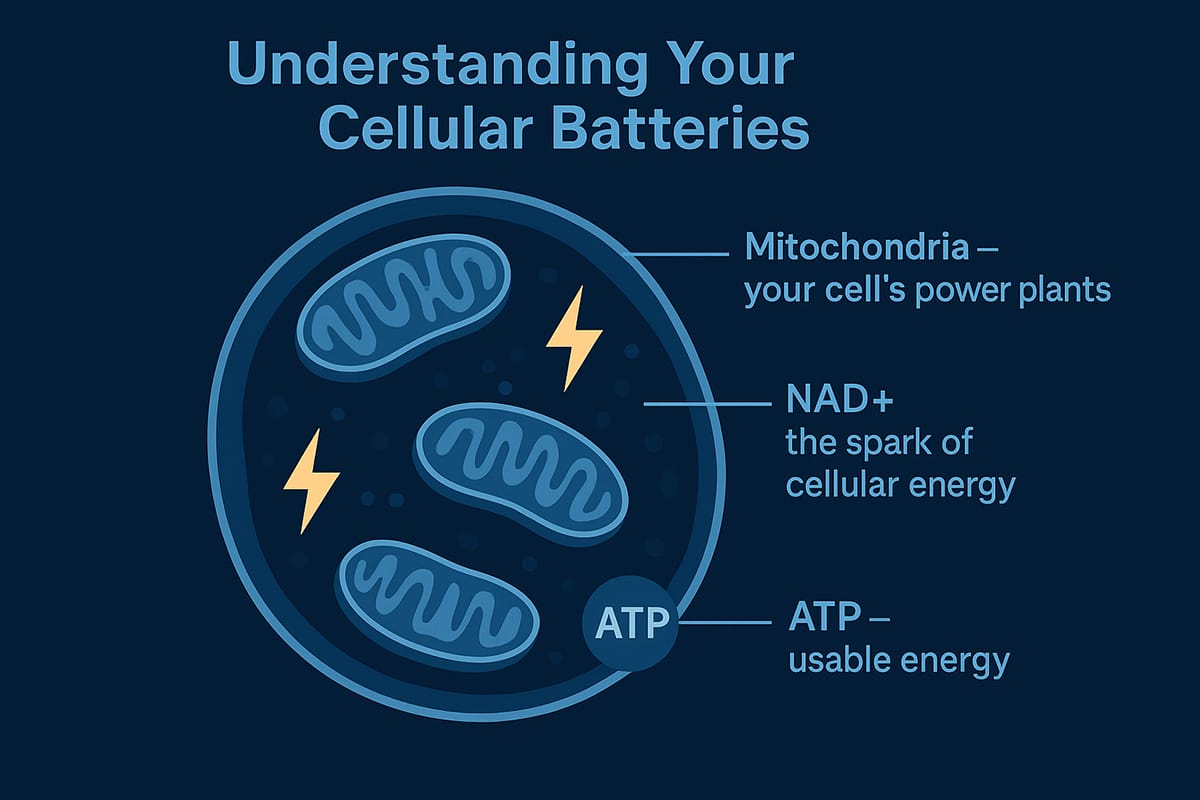
The same wear is happening in cells you can't see. Every cell in your body runs on a molecule called NAD+. It is how a cell turns food into energy, how it repairs its own DNA, and how it powers its antioxidant defences. Tissue studies suggest that by 70 we may be running on as little as a third of the NAD+ we had at 30.
Think about what that means for the cells that make hair colour. Less energy, slower repair, fewer defences against the peroxide. Now think about every other cell doing a harder job than that: your leg muscles on a long walk, your brain at three in the afternoon, the muscles you used in the garden on Saturday that are still complaining on Monday.
To be clear about one thing: this is not about your hair colour. The grey is a marker. The tiredness, the fog and the slow recovery are the same story told by cells you can't see.
What a Cambridge neuroscientist built for those cells
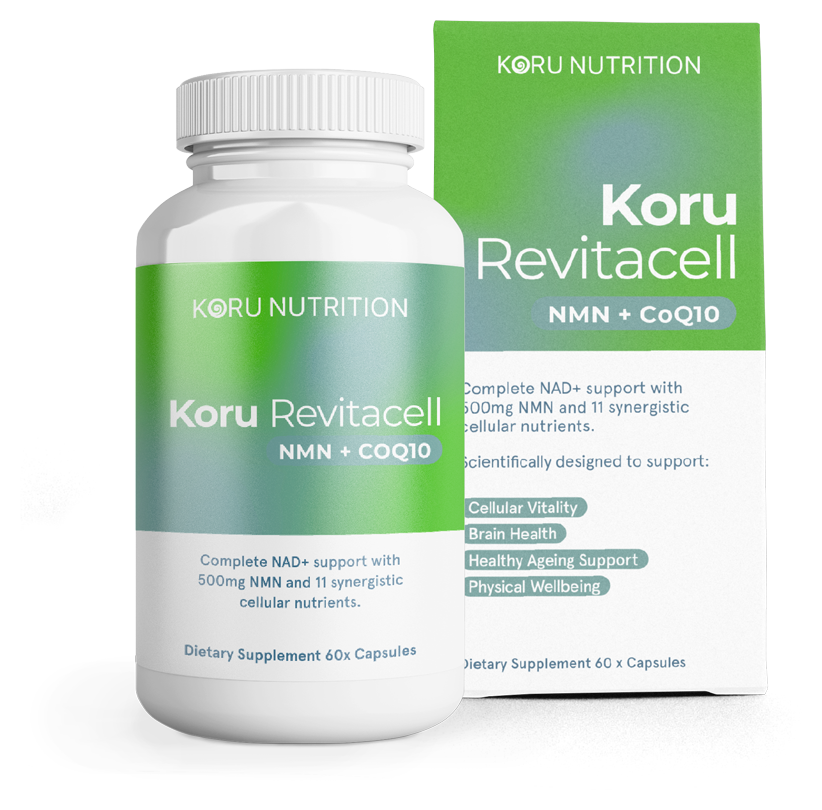
Koru Nutrition, the Rangiora company behind Koru FX and Koru Joint, worked with a Cambridge University neuroscientist on a formula for exactly this. Koru Revitacell carries a full 500mg of NMN, the direct precursor to NAD+, and then something most NMN capsules leave out: the eleven nutrients that convert it, protect the energy it makes, and recycle the by-products so the cycle keeps turning.
How the formula works

Replenish
500mg NMN, one enzyme step from NAD+, with magnesium for the enzymes that make the conversion.
Optimise
CoQ10 as ubiquinol, alpha-lipoic acid and vitamin C help the mitochondria turn NAD+ into usable energy and protect that energy from oxidative damage.
Recycle
TMG, active B vitamins and pterostilbene support the methylation cycle that clears NAD+ by-products, and the sirtuins NAD+ fuels.
Koru Revitacell is made in Rangiora, New Zealand, and tested batch by batch by an independent laboratory.
It has been tested in people, not just in a lab. In a 60-day placebo-controlled trial of 80 healthy adults aged 40 to 65, blood NAD+ rose significantly at every NMN dose from 300mg a day, and the NMN groups walked further in six minutes than the placebo group at day 30 and day 60.
"At 73 I wanted to give my system some good support"
Hermione is one of the customers who has stayed with it. "Wouldn't be without it," she wrote in her review. "It's true that it takes the first four bottles to feel the steady lift that you hear talked about by others. At 73 I wanted to give my system some good support, this seems to be the answer."
Customers describe a change that arrives somewhere between week four and week twelve and is easier to see looking back than in the moment.
Miriam put it in five words: "Definitely feel better, more spring in my steps." Poppy: "Certainly more energy, and I don't have that 3 o'clock slump anymore."
The mirror already told you
You can't see your mitochondria. You can see your hair. If the grey arrived a while ago and the afternoons have got heavier since, those two facts belong in the same sentence.
Two capsules each morning with food. That's the routine. If you'd rather talk to someone first, the team in Rangiora answers on 0800 99 99 80, or you can read the full label and order online here.
Reader offer
Try Koru Revitacell
A full 500mg of NMN plus the eleven nutrients that convert, protect and recycle it. One capsule, the whole pathway.

From $59.99 a bottle
60-day money-back guarantee, empty bottles included
Claim the reader offer →