It arrives at the same time every afternoon. It isn't the lunch.
It arrives at the same time every afternoon. It isn't the lunch.

You know the hour. Somewhere around three. The morning was fine. Lunch was nothing special. Then the room gets heavier, the words take a second longer to arrive, and the couch starts making its case.
You didn't used to plan your day around it. Now you do. The grandchildren get the morning slot. The garden gets done before lunch or not at all. The book club moved to eleven because half the room was fading by four.
What you've told yourself
Everyone has a theory. It's the lunch. It's the heat. It's the heavy meal last night. And underneath all of them, the one nobody says out loud: it's age, and this is just how afternoons are now.
So you've tried the fixes. A second coffee, which buys forty minutes and costs you the night's sleep. A sugary something. A walk round the block. A twenty-minute lie-down that turns into an hour. None of it changes the fact that tomorrow, at three, it comes back.
Here's the thing about a problem that arrives at the same hour every day: it isn't random, and it isn't willpower. Something is running out on a schedule.
What is actually running out
Every cell in your body runs on a molecule called NAD+. It is how a cell turns your breakfast into energy you can use, how it repairs itself, and how it copes with the day. Your body makes less of it every year. Tissue studies suggest that by 70 we may be running on as little as a third of what we had at 30.
A cell with a third of its fuel does the morning fine. By mid-afternoon it has spent what it had. That is the hour. That is the heaviness in the room. Your cells are not lazy. They are running on a smaller tank than they used to, and they empty it at about the same time every day.
The people who built something for it
Koru Nutrition is a small team in Rangiora, north of Christchurch. They make Koru FX and Koru Joint, and they've been hearing about the afternoon from their customers for years. So they went to a Cambridge University neuroscientist and asked for a formula built for the cells, not for the symptom.
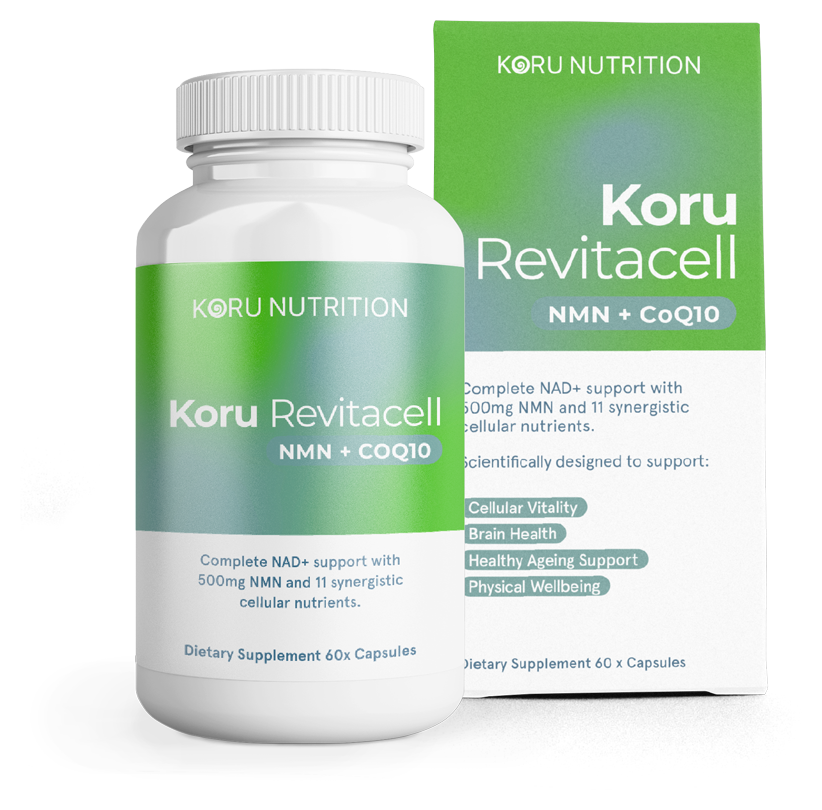
What came back is Koru Revitacell. A full 500mg of NMN, the direct precursor to NAD+, so the tank gets refilled. Then the part most NMN capsules leave out: eleven more nutrients that convert the NMN, protect the energy it makes, and recycle the by-products so the cycle keeps turning tomorrow and the day after.
How the formula works

Replenish
500mg NMN, one enzyme step from NAD+, with magnesium for the enzymes that make the conversion.
Optimise
CoQ10 as ubiquinol, alpha-lipoic acid and vitamin C help the mitochondria turn NAD+ into energy you can use, and protect it from oxidative damage.

Recycle
TMG, active B vitamins and pterostilbene support the methylation cycle that clears NAD+ by-products, and the sirtuins NAD+ fuels.
Koru Revitacell is made in Rangiora, New Zealand, and tested batch by batch by an independent laboratory.
It has been tested in people. In a 60-day placebo-controlled trial of 80 healthy adults aged 40 to 65, blood NAD+ rose significantly at every NMN dose from 300mg a day, and the NMN groups walked further in six minutes than the placebo group at day 30 and day 60.
The plan is two capsules and a calendar
Two capsules each morning with food. Keep the bottle by the kettle so it happens without thinking. Then mark week eight on the calendar and don't judge it before then. This isn't caffeine. Nothing happens on day one. Customers describe a lift that arrives between week four and week twelve, and most of them say they only noticed it looking back.
What looking back sounds like
Poppy had the hour. "Certainly more energy, and I don't have that 3 o'clock slump anymore."
Vanessa noticed it the other way round, by the nap she didn't take. "The afternoon siesta has gone. I tried one day and realised I wasn't sleepy." In its place, she says, "a clearer head, ready to take on things that would otherwise have been put off."
Mike, who spent thirty years as a clinical nutritionist and went in sceptical, landed on the same hour. "What surprised me was the boost in afternoon energy!" Fleur: "I don't get as tired as I used to, and when tired I pick up a lot quicker."
And Jen, a grandmother of two, whose picnic and snow-day photos open and close this story, kept her review short: "I love Koru Revitacell. I was surprised at just how much of a difference it made. Koru's excellent to deal with and always just an 0800 call away."

Or the afternoons keep shrinking
The alternative is the one you already know. The morning slot gets a little shorter each year. The things that live after three o'clock, the walk, the visit, the second half of the garden, quietly move to another day, and then to no day. Not because you've decided anything. Because the tank empties at three.
Which is the whole reason the guarantee runs sixty days, empty bottles included. Take it every morning for two months. If your afternoons haven't changed, ring the team in Rangiora on 0800 99 99 80 and they refund you. Or read the full label and order online here.
Reader offer
Try Koru Revitacell
A full 500mg of NMN plus the eleven nutrients that convert, protect and recycle it. One capsule, the whole pathway.

From $59.99 a bottle
60-day money-back guarantee, empty bottles included
Claim the reader offer →