
Can houseplants really clean the air? What the NASA study actually found

Somewhere near the till of every plant shop is a chalkboard announcing that a peace lily will purify your air. The claim has been repeated so often, on so many chalkboards, that it has achieved the status of common knowledge. It traces back to a single source: a NASA study from 1989. The study was real, and rather good. What happened to it afterwards is a lesson in how science becomes folklore.
NASA's problem was space stations: sealed cans in which the plastics, adhesives and electronics slowly exhale chemicals with nowhere to go. A researcher named Bill Wolverton put common houseplants into small sealed chambers, injected such compounds, and measured what happened. The plants took them out of the air, impressively so, and later work showed much of the labour was done not by the leaves but by microbes living in the potting soil. As an answer to the question "could greenery help scrub a sealed spacecraft," it was promising.
Your lounge, however, is not a sealed perspex chamber, and this is where the chalkboard parts company with the paper. A house leaks and breathes; air moves through it constantly, in volumes that dwarf what any pot plant processes. In 2019 two American engineers gathered the chamber studies and did the unglamorous arithmetic of scaling them to a real building. Their conclusion: to match the cleaning effect of ordinary ventilation, the air exchange a home does anyway, you would need somewhere between ten and a thousand plants per square metre of floor. Not per room. Per square metre. The lounge this implies is not a lounge with plants in it; it is a jungle you have inserted a sofa into.
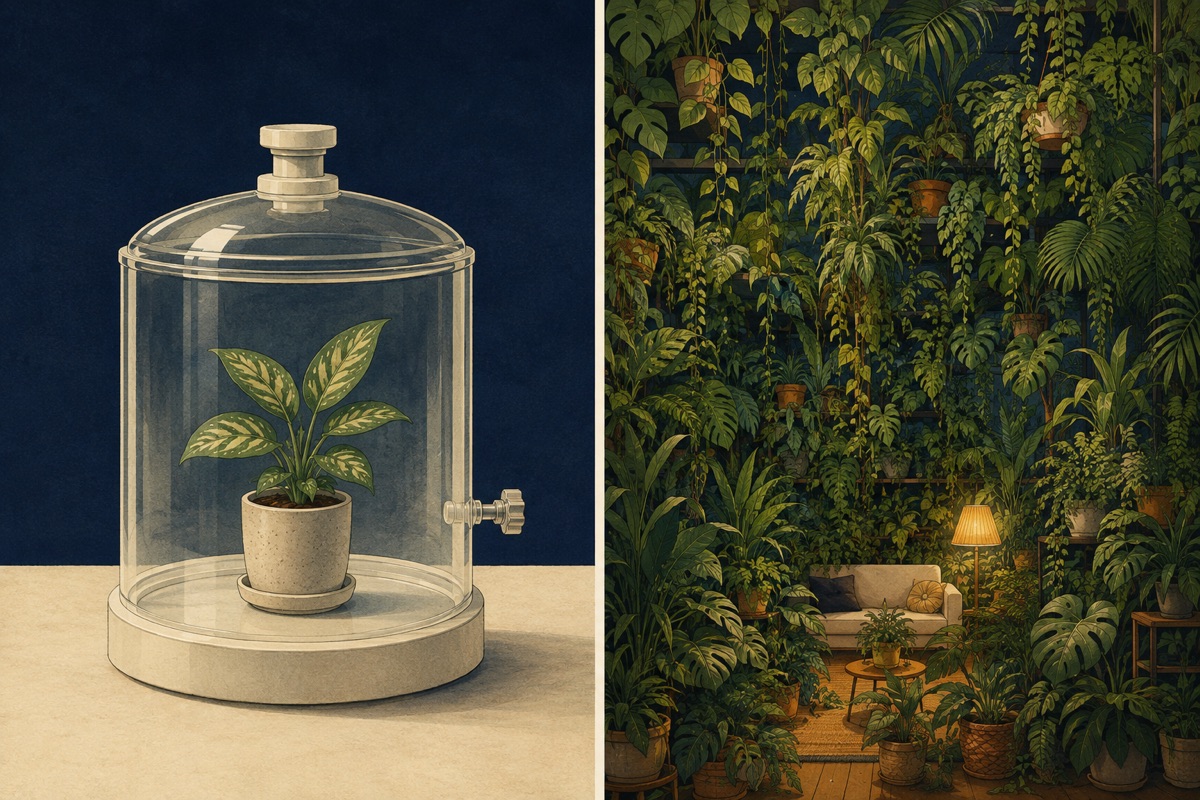
So the honest answer to the chalkboard is no: three ferns and a monstera are not purifying anything measurable. If air quality is the concern, the window wins in a canter, which is a large part of why the ten-minute winter airing earns its own article on this site.
And yet nobody should march their plants to the kerb, because the case for them was never really chemical. Living with greenery is reliably pleasant in ways researchers keep finding modest evidence for: people report better mood around indoor plants, and the small daily routine of watering and picking off dead leaves gives the day one more gentle structure, the same quiet benefit that keeps gardeners gardening. The evidence here is suggestive rather than ironclad, and honestly, it does not need to be ironclad to justify a fern.
Keep the plants, then, but reassign them. They were never your air filtration system. They are company that happens to photosynthesise, and the window was doing the other job all along.